I've also published my first sole authored paper entitled 'A review of Computational Fluid Dynamics (CFD) airflow modelling over aeolian landforms' in the journal Aeolian Research. It's available free to download using the link in this blog until mid-October so get clicking!
Sunday, 4 September 2016
Hope!
I've also published my first sole authored paper entitled 'A review of Computational Fluid Dynamics (CFD) airflow modelling over aeolian landforms' in the journal Aeolian Research. It's available free to download using the link in this blog until mid-October so get clicking!
Thursday, 5 November 2015
NEW ARTICLE: The dune effect on sand-transporting winds on Mars
![]() |
| Sand ripples on Mars (Image: NASA/JPL-Caltech/University of Arizona) |
Our latest article published in Nature Communications demonstrates that local dune topography exerts a strong influence on wind speed and direction above the surface of Mars. Ripple movement likely reflects steered wind direction for certain dune ridge shapes. These findings highlight the need to first model winds at high resolution before inferring regional wind patterns from ripple movement or dune orientations on the surface of Mars today.
The full open access article is available here.
Thursday, 10 September 2015
World War I Shipwreck in the Irish Sea: Surveying
![]() |
| Multibeam data from the SS Polwell (source: http://scientistsatsea.blogspot.ie/)
Surveying for our project investigating WWI shipwrecks in the Irish Sea is in full swing. Follow the teams progress here
|
Tuesday, 7 April 2015
Snow Dunes.
Hope you enjoy the few snaps below from our two weeks in the snow. Thom.
Monday, 16 March 2015
NEW ARTICLE
Patrick Hesp's and my latest collaboration 'Aeolian dynamics of beach scraped ridge and dyke structures' has just been published in Coastal Engineering. Free access to the article, without registration or sign up, is available until May 5, 2015 so get clicking!
Tuesday, 3 February 2015
Investigating WW1 wrecks in the Irish Sea
A group of researchers from Ireland, Wales, Denmark and Australia have been awarded 15 days ship time on the Research Vessel Celtic Voyager by the Marine Institute (Ireland). The group led by Dr Ruth Plets (University of Ulster) aims to acquire high-resolution sonar and optical data which will be used for research into archaeological, biological and physical processes, 3D visualization and cultural heritage management of a number of World War 1 wrecks.
My primary role in the project will be to conduct computational fluid dynamic (CFD) modelling at select wreck sites with a view to understanding fluid flow, scouring and preservation issues, with the aim of creating effective management strategies.
Read the full article here.
My primary role in the project will be to conduct computational fluid dynamic (CFD) modelling at select wreck sites with a view to understanding fluid flow, scouring and preservation issues, with the aim of creating effective management strategies.
Read the full article here.
![]() | |
|
Sunday, 7 December 2014
New Article!
Examples of wind flow steering over a foredune for three incident wind approaches
Chuffed to announce that my first article in collaboration with Patrick Hesp, Flow deflection over a foredune, is now available in press from Geomorphology. Patrick was the most cited author in my PhD thesis and its a real pleasure to be working with him here at Flinders. Here's to many more!
Tuesday, 25 November 2014
Monday, 13 October 2014
Spray Day
I've been fortunate to be involved in lots of different fieldwork the last few years but today was the first that involved taking to the air!
In conjunction with Airborne Research Australia two planes were flown along the Young Husband and Sir Richard Peninsula's here in South Australia measuring salt spray along the coast.
Both planes in flight along one of the sites.
Another 'action' shot.
Dr Graziela Miot Da Silva as part of the ground based team.
Wednesday, 8 October 2014
ICAR 8 and the Badain Jaran Desert
In July the International Society for Aeolian Research held its biennial conference in Lanzhou, China. As part of the conference we were fortunate to visit the Badain Jaran desert which hosts some of the tallest dunes of earth.
As well as some massive dunes, over 140 lakes can be found between the dunes in Badain Jaran desert.
A trip to Minqin desert control experiment station was also organised. Checkerboarding from the bus!
Chinese hospitality after a long day on the road, Inner Mongolia.
Chinese Nebkha
Yours truly rolling the prayer wheels in Ta'er Monastry
Saturday, 23 August 2014
Online seminar: Sand dunes, Shipwrecks and Space
I recently gave a presentation as part of Flinders University 'Environment Matters!' seminar series.
The seminar and presentation slides can be viewed online or downloaded here.
Wednesday, 16 July 2014
NEW PUBLICATION : Sediment transport patterns in a trough blowout
The trough blowout investigated in the study. (County Donegal, Ireland.)
This study examines the variability of sediment flux and its relationship with near surface wind in a trough blowout. Results demonstrated that sediment flux rates were highly variable even over distances of less than 0.5 m. Where wind flow was steadiest, flux was greatest, consequently highest rates of sediment transport were measured on the erosional walls of the blowout. Interestingly however, correlation between sediment flux and wind parameters was best in the centre of the blowout and poorest on the erosional wall crest.
Authors: Thomas Smyth, Derek Jackson and Andrew Cooper
Published in Earth Surface Processes and Landforms
Thursday, 5 June 2014
Fieldwork - Northern California 2014
Unloading the gear. Thankfully we didn't have to bring all this from Australia!
Calibration time. Ian Walker and Michael Grilliot from the University of Victoria check the instruments
Dunes, glorious dunes.
Making use of all that drift wood
Yours truly enjoying the west coast sunshine!
Tuesday, 8 April 2014
The Coorong
Patrick, Stefano (a visiting PhD student from Italy) and I took a trip down to the Coorong National Park at the weekend. This was my first visit and I was blown away by the coastline. So much variety in wave energy and dune types all on one beach. From no energy in Lacepede Bay in the South to a very high energy environment at the Murray Mouth. Hopefully it will make the perfect laboratory!
The Granites. The only rock on 194 km of continuous beach.
It's hard to fully appreciate the scale of the landforms here and the processes that drive their evolution.
Australia's second longest continuous beach.
Wednesday, 19 March 2014
My first foray into marine archaeology
Shortly after completing my PhD last year I was presented the opportunity to use the computational fluid dynamics (CFD) techniques I've been predominantly applying over coastal dunes, to the marine environment.
In collaboration with Dr Rory Quinn, from the University of Ulster, we simulated the fluid dynamics around a shipwreck on the Arklow Bank, Ireland. The simulations confirmed that flow velocity and turbulence are both amplified by the presence of the wreck, causing changes in the morphology of the flow regime, causing changes in the morphology of the flow regime.
The study has recently been published in the Journal or Archaeological Science. Please click here for the full article.
Monday, 10 March 2014
Sand dune migration in an arid coastal dune field
Maspalomas is a coastal dune field situated on the south coast of Gran Canaria. With an annual precipitation of less than 100 mm, the area is very arid with sparse vegetation. Predominant winds blow from the northeast, forcing the dunes to migrate toward the south west. Mapping of dune migration has found that those closest to the shoreline, move faster than those further inland.
Simulated wind speed 0.5 m above the surface of the study site. Vectors on the map represent wind speed and direction at 61 dune crests within the study area.
Top image represents flow across a 640 m cross sectional profile of the study area. The middle image shows flow in lee of a large inland dune. note the large zone of flow separation and re-circulation. The bottom image is of a smaller dune close to the shoreline behind which flow slows, but remains attached.
This post is a summary of an article published by Jackson et al., 2013 in the Journal of Coastal Research. Please click the link below to view the full article:
Labels:
Aeolian,
CFD,
Gran Canaria,
Maspolomas,
OpenFOAM,
Research,
Wind flow
Sunday, 2 March 2014
How do patterns of wind flow change with wind speed?
Complex blowout that wind flow was measured and simulated over. Each point denotes the location of a 3D ultrasonic anemometer
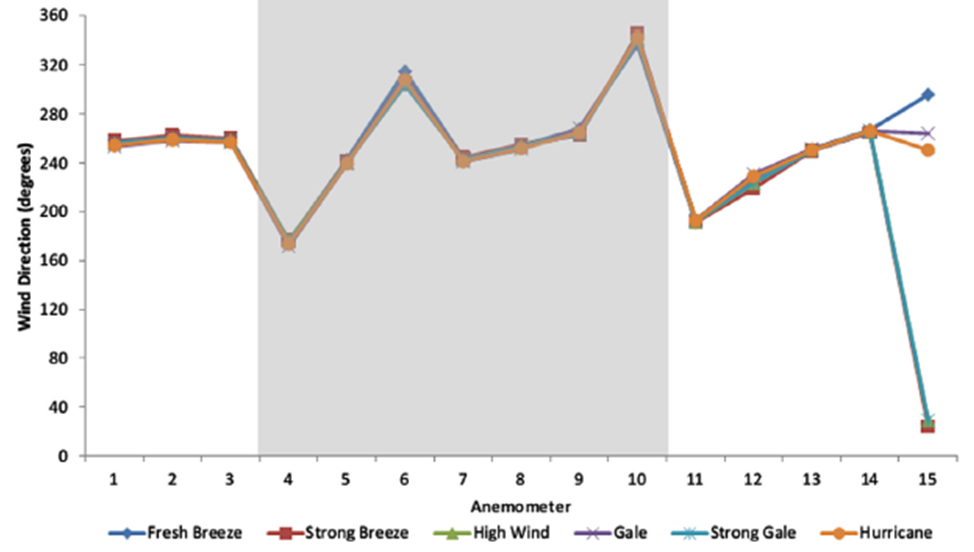
It is sometimes perceived that patterns of wind direction over dunes, including zones of flow reversal and acceleration, change with wind speed. A recent paper by Smyth et al., 2013 published in Aeolian Research found that that patterns of flow steering remained constant even during hurricane force winds.
Measured wind direction at 15 points
Measurements made by 15 ultrasonic anemometers of wind flow at 1 m above the surface at 15 locations in a complex blowout during from fresh breeze to strong gale found that wind flow steering remained remarkably constant. A validated computational fluid dynamics (CFD) model was then used to simulate flow during hurricane force winds. Wind direction at the 15 points during hurricane force winds also did not vary from those at lower incident velocities.
Simulated wind direction in a blowout during fresh breeze to hurricane force winds
Smyth, T.A.G., D.W.T., Jackson, J.A.G. Cooper (2013), Three dimensional airflow patterns within a coastal blowout during fresh breeze to hurricane force winds, Aeolian Research, 9, 111 - 123
Tuesday, 16 July 2013
About Me
I have with experience in both lab and field based research with particular interests in computational fluid dynamics (CFD) modelling of near surface flow in marine, terrestrial and martian environments, the measurement of near surface wind flow over complex topography using ultrasonic anemometry, GIS and wave modelling.
I completed my PhD entitled Airflow and sediment transport dynamics in coastal dune blowouts at the University of Ulster supervised by Professor Derek Jackson and Professor Andrew Cooper.
google-site-verification: googlec31c00cf1c40e0b3.html
Subscribe to:
Posts (Atom)


.png)